
Every frontier model has an effort setting, sometimes called reasoning or thinking levels. The assumption is simple: more effort means more thinking, which means a better result and a bigger bill. I burned through 1.4 billion tokens to see if that holds up.
The short answer is that high is the sweet spot. Below it, results are hit or miss. Above it, you mostly pay more for the same game.
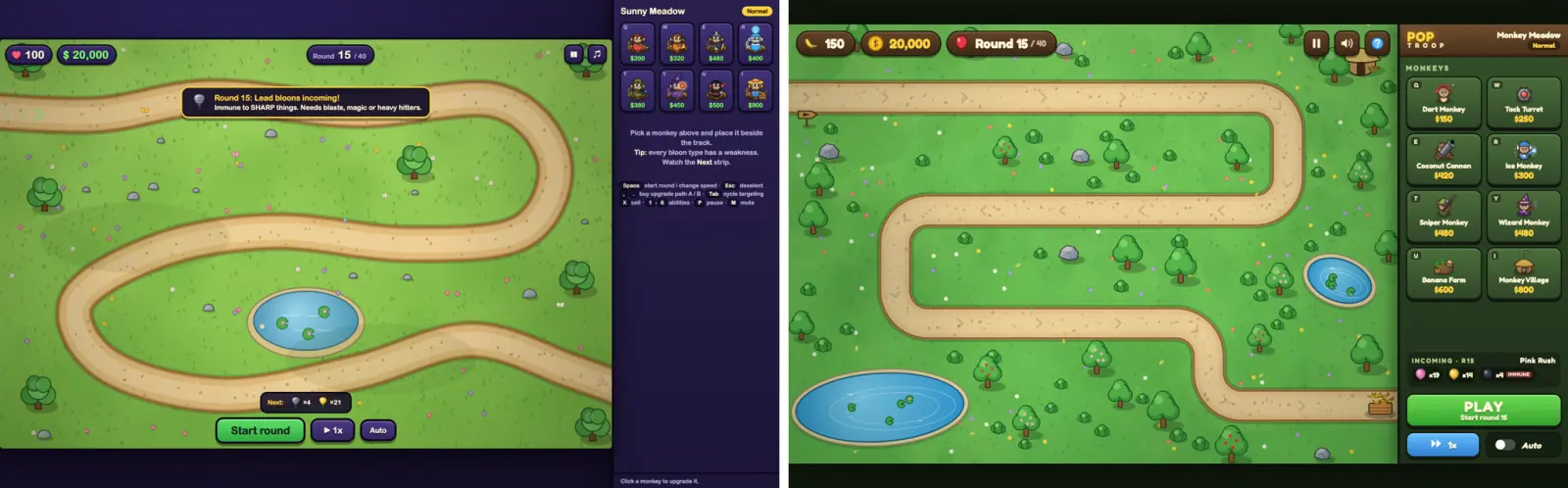
Both of these are Sonnet 5.5. The one on the left ran on high: 57 minutes, $13.77, a score of 7.8. The one on the right ran on max: 4 hours 51 minutes, $162.90, a score of 7.4.
The test
I gave six models a fresh folder and the same goal: build Bloons Tower Defense from scratch in the browser. The prompt was about a paragraph long and left vague on purpose, because I wanted to see how deep each model would go on its own.
Bloons makes a good test because the basics are simple, monkeys throwing darts at balloons, but the real game has layered balloons, camo, upgrade paths, an economy and a boss blimp. A model can stop at the basics or keep going.
That made 27 games. I played every one, reviewed the code, and scored each from 1 to 10 on graphics, complexity, quality and creativity.
Two caveats. Each setup ran once, so small differences are noise and I only looked for big patterns. And the Claude runs had my personal settings loaded, which I've removed from later tests.
The scores
| Model | Low | Medium | High | Extra-high | Max or ultra |
|---|---|---|---|---|---|
| Claude Opus 5.5 | 5.9 | 6.1 | 7.8 | 8.3 | 8.9 |
| Claude Sonnet 5.5 | 5.8 | 5.3 | 7.8 | 7.8 | 7.4 |
| Claude Fable 5.1 | 7.4 | 7.3 | 8.3 | 7.5 | not run |
| GPT-6.1 | 3.3 | 5.4 | 6.0 | 5.8 | 5.6 |
| GPT-6 Astra | 4.4 | 5.5 | 5.5 | 5.6 | not run |
| GPT-6 Sol | 2.5 | 3.0 | 4.1 | 5.0 | not run |
On the Claude side, three things stood out:
- Low and medium are about the same, and there's a big jump to high. Going up in effort isn't guaranteed to help, though: Sonnet on low scored a little higher than Sonnet on medium.
- Past high, the returns drop off fast. Only Opus kept meaningfully improving all the way to max.
- Fable barely cared. Low, medium, high and extra-high all landed within a point of each other, and not in the order you'd expect. It was also the only model that was genuinely good on low.
OpenAI was well behind. Its best score, a 6.0, beat only three of the Claude builds. The problem wasn't really bugs. It was depth: usually one map, one difficulty and five or six towers, with similar art and names across builds. Part of that is on my prompt, since I didn't ask for more. The GPT models did complete it. The Claude models just went well beyond it.
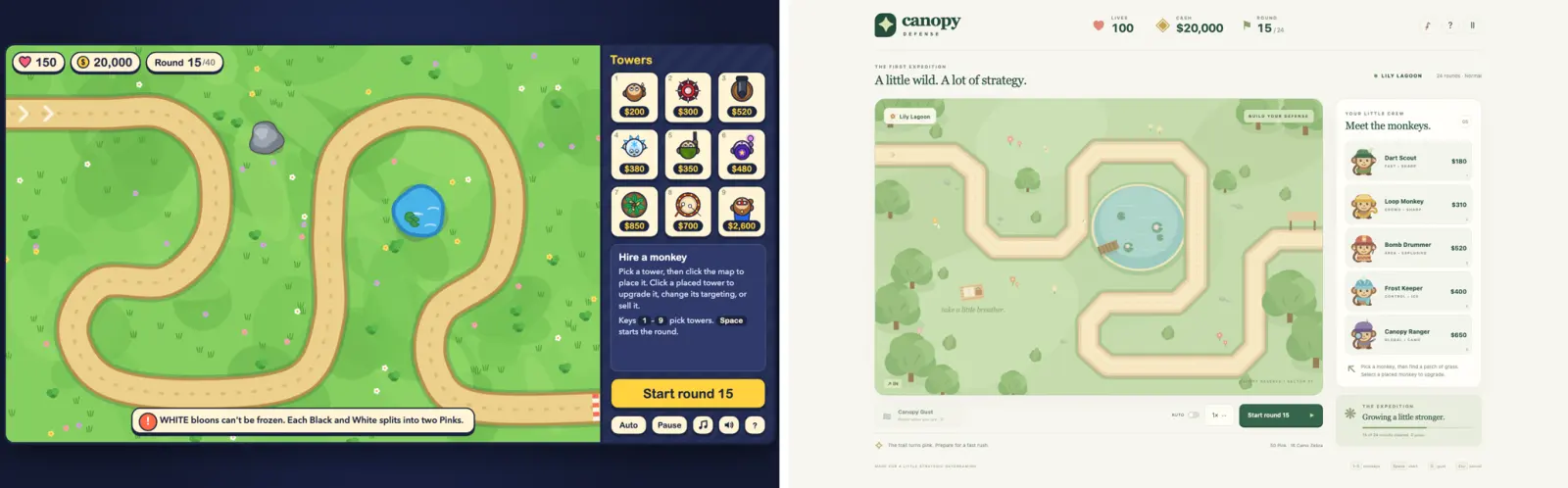
That's Fable 5.1 on high on the left (8.3) and GPT-6.1 on high on the right (6.0). GPT-6.1 costs far less, and you can see where the money went.
What it cost
The dollars don't simply follow the sticker price.
- Fable is cheaper than it looks. Per token it's about two and a half times the price of Opus, but it gets more done per step. Fable on high used 11.4 million tokens where Opus on high used 44.3 million.
- Opus is good value, especially on high. You could argue for extra-high and max too, since it kept improving.
- Sonnet burns tokens to get there. It keeps working until the result is decent. On max it went through over 640 million tokens. If you feel you need to push Sonnet that far, you're probably better off switching to Opus or Fable.
- OpenAI used about a tenth of the tokens of Opus and Sonnet, and built a lot less. Raising the effort only adds a few million tokens per level. Astra didn't care much either: it used about twice as many tokens on low and medium as it did on high.
What it cost in time
Time follows tokens. Sonnet on high finished in under an hour, extra-high took over two hours for the same score, and max ran for almost five. Fable on low took 22 minutes to match Sonnet on max.
Fable on high took 49 minutes to score an 8.3. Opus took 1 hour 37 minutes to match that, and only beat it on max, after 2 hours 8 minutes. Sonnet never got there.
The OpenAI models all finished in 33 minutes or less, but fast doesn't help much when the result isn't that good.
What I'd do
- Default to high. Opus 5.5, Fable 5.1 or GPT-6.1 on high are where you get the most for your money.
- On OpenAI, start with GPT-6.1 on high. I'd skip GPT-6 Sol, which is weaker, burns more tokens and won't save you real money. And I'd save Astra for genuinely hard problems where you're willing to write a very specific prompt.
- Don't use low, unless it's Fable. A weaker model on a higher setting usually beat a stronger model on low. Sonnet on high beat Opus on low by nearly two points.
- If you care about waiting, use Fable. It's also cheaper than you'd think, so use it more often than you think you should.
All 27 builds
| Build | Score | Time | Cost | Tokens |
|---|---|---|---|---|
| Claude Opus 5.5, max | 8.9 | 2h 08m | $60.39 | 149.8M |
| Claude Fable 5.1, high | 8.3 | 49 min | $18.62 | 11.4M |
| Claude Opus 5.5, extra-high | 8.3 | 1h 37m | $39.96 | 98.9M |
| Claude Sonnet 5.5, extra-high | 7.8 | 2h 15m | $40.03 | 151.0M |
| Claude Sonnet 5.5, high | 7.8 | 57 min | $13.77 | 45.5M |
| Claude Opus 5.5, high | 7.8 | 1h 17m | $18.54 | 44.3M |
| Claude Fable 5.1, extra-high | 7.5 | 54 min | $27.26 | 14.3M |
| Claude Fable 5.1, low | 7.4 | 22 min | $14.19 | 5.8M |
| Claude Sonnet 5.5, max | 7.4 | 4h 51m | $162.90 | 640.8M |
| Claude Fable 5.1, medium | 7.3 | 33 min | $16.01 | 10.5M |
| Claude Opus 5.5, medium | 6.1 | 45 min | $12.64 | 27.0M |
| GPT-6.1, high | 6.0 | 27 min | $1.40 | 3.8M |
| Claude Opus 5.5, low | 5.9 | 29 min | $8.07 | 17.3M |
| Claude Sonnet 5.5, low | 5.8 | 23 min | $5.78 | 16.2M |
| GPT-6.1, extra-high | 5.8 | 33 min | $1.88 | 7.0M |
| GPT-6.1, ultra | 5.6 | 26 min | $2.86 | 10.0M |
| GPT-6 Astra, extra-high | 5.6 | 27 min | $7.71 | 3.7M |
| GPT-6 Astra, high | 5.5 | 19 min | $4.95 | 1.6M |
| GPT-6 Astra, medium | 5.5 | 26 min | $7.53 | 3.3M |
| GPT-6.1, medium | 5.4 | 32 min | $0.97 | 2.6M |
| Claude Sonnet 5.5, medium | 5.3 | 16 min | $3.50 | 8.8M |
| GPT-6 Sol, extra-high | 5.0 | 20 min | $2.29 | 7.6M |
| GPT-6 Astra, low | 4.4 | 16 min | $5.31 | 3.1M |
| GPT-6 Sol, high | 4.1 | 17 min | $1.60 | 4.5M |
| GPT-6.1, low | 3.3 | 10 min | $0.43 | 1.4M |
| GPT-6 Sol, medium | 3.0 | 14 min | $1.60 | 5.3M |
| GPT-6 Sol, low | 2.5 | 5 min | $0.46 | 1.1M |
Costs are what each run would cost at the model's list API price, and tokens include cached re-reads. The runs actually used subscriptions. Sonnet's cache price has been cut since, so its costs would be lower today.
Sonnet on high ran twice. The first run quietly handed the build to four Opus subagents and cost $53.34, for a 7.6, so the table uses the second run.
Times are active work. Astra on high and GPT-6.1 on ultra each stopped early and needed a "keep going" message, and Opus on max sat idle for hours before writing its final report. GPT-6.1 on extra-high also opened another build's page a few minutes in and saw its on-screen text, which it disclosed.
You can play every build, and read the exact prompt, on the Bloons page in the Lab. It has grown to 41 builds since this test, including Haiku, Kimi and teams where one model plans and another writes the code.