
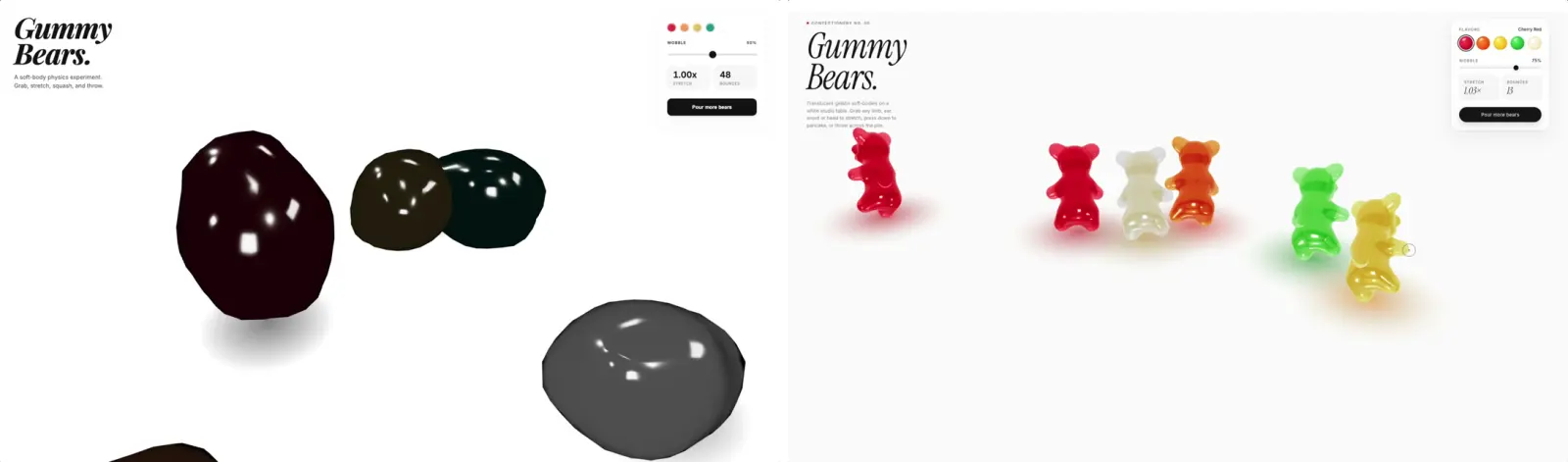
Same prompt, two Google models. Gemini 3.1 Pro built black blobs mashed together and got a 1 out of 10. Gemini 4 Argon built see-through bears that wobble, and got an 8. So I put Argon up against the best models from Anthropic, OpenAI and xAI.
The test
One prompt, word for word, from a Reddit post: a single three.js HTML file with gummy bears on a white table. They should look like real candy and feel like jelly, not plastic. You grab and stretch them, press them flat, throw them, and pour in a whole handful.
Every model got an empty folder, its highest setting, and nobody answering its questions. Claude ran in Claude Code, OpenAI's models in Codex, Grok in Cursor and both Gemini models in Gemini CLI. I played every build and scored it myself.
The scores
| Model | Score | Time | Cost |
|---|---|---|---|
| Claude Opus 5.5 | 9.7 | 49 min | $13.48 |
| GPT-6 Astra | 9 | 17 min | about $4.69 |
| Claude Fable 5.1 | 8.5 | 89 min | $40.07 |
| Gemini 4 Argon | 8 | 51 min | about $3.97 |
| GPT-6.1 Sol | 6.5 | 31 min | about $1.68 |
| Grok 4.7 | 3.5 | about 69 min, then it hung | none |
| Gemini 3.1 Pro | 1 | 3 min | about $0.45 |
The two OpenAI costs are API-equivalent. Those runs went through my ChatGPT plan. Grok has no cost because Cursor doesn't report tokens.
What stood out
Argon finishes fourth of seven. Astra is the one that should worry Google: it scored a point higher, in about a third of the time, for roughly 70 cents more.
Gemini 3.1 Pro was faster and cheaper than Argon, but only because it barely tried. It made three tool calls and never opened the page. Argon made 111 and kept checking its own work.
Build by build:
- Opus 5.5 took first, which didn't surprise me. On extra-high it's been the best model in my testing by far.
- Astra was the surprise. Its bears are a little less see-through and there's some clipping when you drag them fast, but the physics are good and it took only 17 minutes.
- Fable 5.1 made good bears, but it took 89 minutes and cost $40. Pour a bunch in and the shadows turn into layered squares.
- Argon has less detail in the faces, and the stripes are a bit odd. But the physics are good, the shadows hold up, and it landed just below Fable for a tenth of the cost.
- Sol gave its bears teeth, which nobody asked for, and they look pixelated on a small canvas. Still, it was cheap and fast.
- Grok 4.7 worked for about 69 minutes, then sat idle for another 49 before I stopped it. They barely look like bears.
Price and access
Argon costs $2 per million input tokens and $10 per million output tokens. That's launch pricing, and Google says it doubles on December 1.
Getting it to run was harder than it should be. Antigravity needs the Ultra plan, and Cursor and OpenRouter both cut the connection while Argon was thinking. Gemini CLI with a paid API key worked.
So is Google back?
This is one prompt and one run each, so don't read too much into the small gaps, and I'll need to test Argon more on everyday coding. But it's a huge step up from Gemini 3.1 Pro, and for the price, I like it.
You can play every build and read the exact prompt on the gummy bears page in the Lab. Turn on "Play blind" if you want to pick a favorite before you see the names. Kimi K3.1 Pro has joined the page since this test, with a score of 5.